The AS Gender & Sexuality Equity Center (GSEC) is happy to announce that we are hiring interns for the Fall 2014 semester! Stop by the Internship Fair on Wednesday, August 27th from 5:00-6:30pm in BMU 005 and get to know the GSEC staff as well as receive more information about the application process.
Applications are due the first Friday of school, August 29th by 4pm to BMU 005!
To receive an application, you can email asgsec.ic@csuchico.edu, or you can follow the link provided below:
http://www.aschico.com/images/cms/544_7_GSEC14_Application_FallInternship08.20.pdf
We are happy to answer any questions regarding the application or the internship!
Slider 1
Thursday, August 21, 2014
Thursday, August 7, 2014
6 Word GSEC Memoirs
At the end of last semester, we asked our interns to restate the mission statement of the GSEC in 6 words based on their experience in the internship. Here are some of their responses:
"Breaking the silence, empowering our communities"
"Making our campus safe through activism"
"Where activism, feminism, and empowerment thrive"
"Empowering all to end the patriarchy"
"Feminist and queer friends fighting norms"
"Challenging societal norms to change tomorrow"
"Bringing down the patriarchy and empowering others"
"No more silence; change is coming"
"Peaceful, fierce activists pushing for change"
"Different backgrounds, different stories, same fight!"
"Have no fear, equity is here"
"Empowering all using feminism and intersectionality"
"Queer spaces for changing patriarchal faces"
"We recruit with a vulva suit"
"Breaking the silence, empowering our communities"
"Making our campus safe through activism"
"Where activism, feminism, and empowerment thrive"
"Empowering all to end the patriarchy"
"Feminist and queer friends fighting norms"
"Challenging societal norms to change tomorrow"
"Bringing down the patriarchy and empowering others"
"No more silence; change is coming"
"Peaceful, fierce activists pushing for change"
"Different backgrounds, different stories, same fight!"
"Have no fear, equity is here"
"Empowering all using feminism and intersectionality"
"Queer spaces for changing patriarchal faces"
"We recruit with a vulva suit"
Friday, May 9, 2014
My Story: Intersecting Feminism and Journalism
I am participating in Diane DeBella’s #iamsubject project http://www.iamsubject.com/the-iamsubject-project/. Here is my #iamsubject story.
I am extremely passionate about two things that don't always play nicely with each other or conventionally go hand-in-hand: feminism and journalism.
I discovered my admiration for both feminism and journalism at when I was a little girl. My family, friends and teachers always thought I was just an outspoken little tomboy who loved to write. It took several years for me to discover that this was just the beginning of my story as a feminist journalist.
That passion was ignited inside me as I realized that little girls and little boys weren't given equal treatment in grade school. That same passion was ignited as I realized how much I loved newspapers after developing a pattern of reading the Sunday paper.
Today, I intersect my passion for journalism and feminism now more than ever. I've spent my final semester of my undergraduate collegiate life as the editor-in-chief at The Orion, an award-winning student news publication at California State University, Chico, and as an intern coordinator at the Associated Students Gender and Sexuality Equity Center.
I really believe that journalism needs feminism. Why? Because there will always be room for improvement. Women are still massively underrepresented in the journalism field.
The Women's Media Center's 2014 Status of Women in U.S. Media Report stated that women comprised 36 percent of newsroom staffs. That figure has been the same since 1999. That startling, but not surprising, statistic has not changed since I was 8 years old.
It also upsets me to discover that the 2012 Byline Survey Report found that women journalists write more articles on subjects that women have traditionally written about, such as gender, food, family and style. Although these topics are important to report on, it's frustrating to know that far less women are writing about "general" news topics like economy, international politics, social activism and security.
I've always wanted to be a news reporter so I could utilize my reporting and storytelling skills to tell the stories of people who remain voiceless by the inequities presented by a patriarchal society. However, I'm consistently reminded how "dangerous" it is for a woman whenever I tell people that I want to travel the world and report on the inequities that people endure. Unfortunately, the International News Safety Institute shows that about 64 percent of women have reported facing threats, abuse and intimidation related to their work.
Journalism needs feminism because women like me are done being told that "real journalism" isn't for women or that it is "too dangerous" for women. Journalism needs feminism because women should feel safe in all workplaces.
One of my many goals in life is to help other women who identify as journalists, feminists and activists find their way of intersecting all of their passions into one. I know it has been extremely difficult for me at times, but I know that my story will help pave the way for other feminist journalists.
As I prepare for my life as a bachelor's degree-holding graduate, I can not wait for the opportunities the future may present me as a journalist. I can not wait to make strides towards changing journalism for all women. As a feminist journalist, I know that I can make the journalism world more fair for women.
By Katrina Cameron
I discovered my admiration for both feminism and journalism at when I was a little girl. My family, friends and teachers always thought I was just an outspoken little tomboy who loved to write. It took several years for me to discover that this was just the beginning of my story as a feminist journalist.
That passion was ignited inside me as I realized that little girls and little boys weren't given equal treatment in grade school. That same passion was ignited as I realized how much I loved newspapers after developing a pattern of reading the Sunday paper.
Today, I intersect my passion for journalism and feminism now more than ever. I've spent my final semester of my undergraduate collegiate life as the editor-in-chief at The Orion, an award-winning student news publication at California State University, Chico, and as an intern coordinator at the Associated Students Gender and Sexuality Equity Center.
I really believe that journalism needs feminism. Why? Because there will always be room for improvement. Women are still massively underrepresented in the journalism field.
The Women's Media Center's 2014 Status of Women in U.S. Media Report stated that women comprised 36 percent of newsroom staffs. That figure has been the same since 1999. That startling, but not surprising, statistic has not changed since I was 8 years old.
It also upsets me to discover that the 2012 Byline Survey Report found that women journalists write more articles on subjects that women have traditionally written about, such as gender, food, family and style. Although these topics are important to report on, it's frustrating to know that far less women are writing about "general" news topics like economy, international politics, social activism and security.
![]() |
| Source: 2012 Byline Survey Report |
I've always wanted to be a news reporter so I could utilize my reporting and storytelling skills to tell the stories of people who remain voiceless by the inequities presented by a patriarchal society. However, I'm consistently reminded how "dangerous" it is for a woman whenever I tell people that I want to travel the world and report on the inequities that people endure. Unfortunately, the International News Safety Institute shows that about 64 percent of women have reported facing threats, abuse and intimidation related to their work.
Journalism needs feminism because women like me are done being told that "real journalism" isn't for women or that it is "too dangerous" for women. Journalism needs feminism because women should feel safe in all workplaces.
One of my many goals in life is to help other women who identify as journalists, feminists and activists find their way of intersecting all of their passions into one. I know it has been extremely difficult for me at times, but I know that my story will help pave the way for other feminist journalists.
As I prepare for my life as a bachelor's degree-holding graduate, I can not wait for the opportunities the future may present me as a journalist. I can not wait to make strides towards changing journalism for all women. As a feminist journalist, I know that I can make the journalism world more fair for women.
Monday, April 21, 2014
Intersectionality and Trans* Immigration
by eliza dyer
The importance of recognizing these intersectional experiences is that we can recognize how all of our oppressions are connected and the extent of the change that is necessary for the equitable treatment of everyone in our communities. For trans* immigrants, we need changes police practices, legal procedures, fund allocation to detention centers, amnesty processes, legal protection based on gender identity, and so on. Trans* immigrants have a strong and unique perspective into the systems that oppress us and we can’t get anywhere worth going without them. We can use this analysis to understand the importance of immigrant organizing and representation to our struggle as queer and trans* people, the importance of the organizing for sex worker rights, the lack of universal experiences in the community we try to represent. This is just one small look into how intersectional analysis works and what trans* immigrants must navigate, but I hope it makes the case of much farther we can go if we acknowledge that our experiences aren’t like everyone else’s and of how much farther we can go when we incorporate that into our activism and world views.
So I’ve been so excited by the success and messages coming from “QPOCS!”’s Queer People of Color Visibility Week on campus, particularly their Intersectionality 101 Workshop. Which, has gotten me thinking about how the queer struggle that I participate in can be more intersectional and better link itself to the struggles of racism and classism. One of the most illustrative examples of intersectionality (the concept that loosely means that we all carry all of our identities with us at all times, and those identities can’t be examined separately) that I like to use is the experiences of Trans* Immigrants. Their immigration status is directly linked to their ethnicity and directly linked with their gender identity which is directly linked to their class status.
This is because their immigration status affects their educational and employment opportunities while their gender identity affects those opportunities in a different and compounding way. This means (particularly undocumented) trans* immigrants are more likely to be economically vulnerable and potentially need to resort to survival crime like sex work to survive than either cisgender immigrants or trans* citizens. Trans* immigrants who are of particular ethnic origins are even more likely than other trans* immigrants. Transwomen who are immigrants are more likely than those with other gender identities. To make this even more complex, this is all important because economically vulnerable people are more likely to come into contact with law enforcement, which exponentially raises the chances for detainment and deportation. This is just to show how useful intersectional analysis is because trans* immigrant individual experiences are directly situated in each identity status.
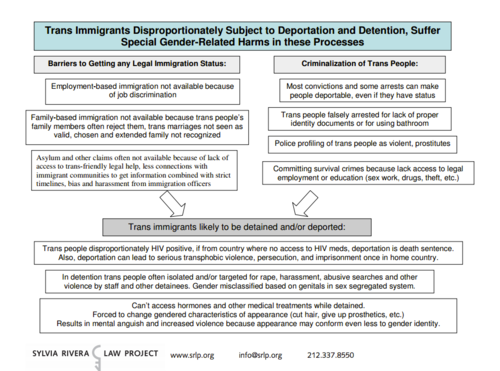
For us visual learners, this is a super useful graph from an awesome organization, the Sylvia Rivera Law Project:
This shows step by step how legal institutions criminalize particularly trans* people and how trans* identities can prevent people from accessing legal immigration status. This includes how trans* people have less access to secure employment, but that most documented forms of immigration require secure employment of a certain wage OR family members to vouch financial support which is much more difficult for trans* immigrants than cisgender immigrants statistically. This graph shows how criminalization and barriers to documented immigration compound to create disproportionate detention and deportation of trans* people, but also that that process for them is much more dangerous for them. This is in part because of the lack of proper medical attention in detention centers and in countries of origin, because of the disproportionate levels of violence faced in detention centers and countries of origin.
The importance of recognizing these intersectional experiences is that we can recognize how all of our oppressions are connected and the extent of the change that is necessary for the equitable treatment of everyone in our communities. For trans* immigrants, we need changes police practices, legal procedures, fund allocation to detention centers, amnesty processes, legal protection based on gender identity, and so on. Trans* immigrants have a strong and unique perspective into the systems that oppress us and we can’t get anywhere worth going without them. We can use this analysis to understand the importance of immigrant organizing and representation to our struggle as queer and trans* people, the importance of the organizing for sex worker rights, the lack of universal experiences in the community we try to represent. This is just one small look into how intersectional analysis works and what trans* immigrants must navigate, but I hope it makes the case of much farther we can go if we acknowledge that our experiences aren’t like everyone else’s and of how much farther we can go when we incorporate that into our activism and world views.
Friday, April 11, 2014
What Does a Feminist Relationship Look Like?
Love and Feminism
The
feminist fight takes on many forms, politically, globally, and personally, but I
feel as feminists, we forget to take care of the home front. What I mean is our
romantic relationships. It’s so easy to
get caught up in the issues that garner the most attention and publicity like
reproductive rights, marriage equality,
and the gender wage gap—all very important and necessary—but are we failing to
challenge patriarchy and oppression in our homes? Are our dating, mating and
marriage practices in alignment with our feminist principles of equity,
collaboration, and the dismantling power and privilege? What I hope to examine
in this blog is what a romantic relationship look like when we practice
feminist principles. My disclaimer is that I can only speak from my own
experiences in a heterosexual relationship with a male identified man who also
is a feminist. I am sure I will not be able to create a complete picture of
what a feminist relationship is but I do hope to at least begin by sketching
out what I have tried to achieve in my own partnership.
Acknowledgement of Sexism and Patriarchy
I think we can all agree that
sexism and misogyny is a huge problem in our society and in the world. Nothing
gets me as a feminist and as a woman more frustrated and dare I say angry when
people—men and women—deny that sexism is a problem. That sexism as a systematic
whole doesn’t really exist and that it’s some people who may have sexist
beliefs but we as a society are not oppressive to women. A feminist
relationship acknowledges that we are in a patriarchal society that values one
gender over another, that rape culture and the wage gap does indeed exist. That
this society and most of the world holds patriarchal values that keeps
masculinity and men’s experiences as the standard or norm and anything else as
other. Without this acknowledgement, a
relationship cannot be based in feminist principles, nor does the partner align
with feminist values. And sometimes, the hard truth is we may be feminist and fighting
the good fight, but our partners can be ambivalent non-feminists or worse
anti-feminists who find the women’s rights and LGBTQ+ rights movement a threat
to their core values.
Commitment to Equity and a True Partnership
I
believe everyone has a “list” of what characteristics they want in a life-long
mate. My deal maker and deal breaker was the fundamental ideological belief
that I as a woman was the equal to my partner. This seems simple enough and maybe obvious,
but you wouldn’t believe how many nice young men I’ve dated who balked at the
idea that I was equally accountable, important, hardworking, smart, deserving etc.
as them. I can’t really blame them with the way we raise boys and girls to
devalue everything that is associated with being female. Of course, my insistence
on equity was going to blow their mind and threaten their long held beliefs.
And for clarification, when I say I demand equity in a relationship and in
society, I am NOT saying I am the same as a man. I am saying I deserve the same
respect, value and opportunities as a man. And maybe that’s where many feminists get
snagged in these types of conversations with family, friends, and strangers is
because people assume feminism is saying
women are better than men (which they aren’t) or by having gender equality
under the law and in practice is saying women and men are the same. A feminist
relationship acknowledges women’s value as just as important and significant as
men’s. A feminist relationship is a true partnership of equals. Not a
parent/child relationship or any of the pretty metaphors we have heard to
justify placing men as the sole leaders and controllers of relationships; remember
My Big Fat Greek Wedding’s famous line “The man is the head, but the woman is
the neck. And she can turn the head any way she wants.” Sure it sounds
empowering but it still supports the hierarchal component of patriarchy. If we
as feminist want to end hierarchal oppression of groups with privilege over
those without we need to confront the hierarchy that has been traditionally
structured our romantic relationships.
Confronting Privilege (In Ourselves and in
Our Partners)
As a white, cisgender,
college educated, able-bodied woman, legally married to a white, educated,
able-bodied man we have a lot of privilege. As feminists it’s our obligation to
acknowledge our privileges, as uncomfortable as that may be, and use our
privilege to help those who are not privileged like the LGBTQ+ community,
people of color, the disabled etc. Confronting privilege takes the form of
calling out our use of language. Saying “that’s so gay”, “that’s retarded”, “That
test raped me” or the use of the “N word” in jest are all products of privilege.
This could be hard, nobody likes to be corrected by their partner, and it could
be interpreted at criticism. It could have easily been a slip, but it’s so
important that we as feminists keep ourselves and our partners accountable. I
have been called out by my partner and I have told him to “check your privilege”.
This can be done in a gentle, joking manner without berating and lecturing your
partner. Male privilege can make it especially hard for a male identified
partner to understand or see the struggles of sexism and patriarchy, there may
be defensiveness, denial, and maybe guilt that comes with being part of a
privileged group. This is where the work of feminism and relationships can be
especially frustrating but ultimately, if he is willing to listen, and if she
is willing to speak of her experiences with sexism and discrimination, rewarding.
There can be understanding even if he still doesn’t agree with her completely.
Negotiating Gender Roles
This I feel is going to be
super obvious and some feminists may wonder why this is it even being
addressed. As feminists we know that gender is socially constructed and we know
that women should be able to work outside the home and men be stay at home
dads, without their gender being compromised and yet, the reality is that
gender roles in hetero relationships play a huge role in the way couples
interact with each other. A real world
example would be the division of labor between men and women. Women are working in the labor force, at the
same hours, doing the same things, yet they are still doing most of the
housework. Some women still expect men to not express too much emotion, or to
communicate about their feelings. A feminist relationship isn’t asking that
women not stay at home with their children and do domestic work or men to not
be the bread winner; it is also not keeping people in these confined boxes. A
feminist relationship requires us to question are own motives and expectations
of our partners. It could be the expectation that your male partner will take
out the trash, not because you asked him or he volunteered but because that is
the traditional male chore. Having conversations and collaborating together
about how the house should be run and what kind of expectations, while being
aware of how gender is influencing these expectations is important in a
feminist relationship.
Valuing and Celebrating Each Other’s
Contributions
A feminist relationship,
however the division of labor is arranged, who works, who makes more money, who
cares for the children, all the contributions to the relationship are
celebrated and valued. We have a tendency in this society to put a higher value
on contributions that have monetary value. That’s why childcare and domestic
work is undervalued but not because it is less work. It doesn’t make income and
is easily dismissed. Any good relationship values the partner and their
contribution and that is especially true in a relationship based on feminist
principles. When we value the work that doesn’t bring in the cash we are
redressing the balance of power that tends to give the partner who makes more
money more control in the relationship. Celebrating a partner’s contribution is
one of the best ways to demonstrate love, and by loving and valuing a partner
we have a healthier, happier relationship.
Conclusion
Relationships are hard and a
lot of work, and trying to root a relationship in feminism will be a lot more
work; but if we expect our homes and relationships to be based on equity,
respect, dignity and value, we start a precedent for our children and these
principles will no longer be a theory or a lip service, but will be an
actuality. We will then be paving a way that will lead the future generations
to social justice and reproductive rights, marriage equality, and the gender
wage gap won’t be these massive battles for our children to fight, or if they
are, they are equipped with the tools to continue our work.
Tuesday, March 11, 2014
First Annual Trans* Conference, TRANS*forming Communities
Rachel Ward, Intern Coordinator
Assistant
AS Gender and Sexuality Equity
Center
(530) 898-5724
FOR IMMEDIATE RELEASE
3-10-2014
First
Annual Trans* Conference, TRANS*forming
Communities
(CHICO, Calif.) – Associated Students Gender and Sexuality
Center will be hosting our First Annual Trans* Conference, TRANS*forming Communities on Saturday, March 29th, from 12
to 5 p.m. This event is taking place in California State University, Chico’s
Bell Memorial Union Auditorium. This free conference will be featuring keynote
speaker Eli Erlick, executive director and founder of Trans Student Equality
Resources. Lunch will be provided.
TRANS*forming
Communities will consist of speakers, workshops, and panels dedicated to
celebrating and honoring the diverse identities and experiences of trans*
people. It will be a safe place for trans* people and allies to come together,
share resources and knowledge, and create a community where people can flourish
and live authentically. Anyone with a desire to learn and better our
communities is welcome.
TRANS*forming
Communities will be followed by Trans* Week, hosted by Stonewall Alliance of
Chico. Check out the event on Facebook, https://www.facebook.com/events/1381104442136354/ or email trans@stonewallchico.org.
Trans*
people need more visibility, and with more visibility comes more understanding.
Many trans* people live in extreme poverty, and are almost four times more likely to have a household
income of less than $10,000 per year. Forty one percent of trans* people have attempted suicide, compared to 1.6%
of the general population. Eighty percent of trans* students feel unsafe
at school because of their gender expression.
Many of the issues facing the general LGBT*Q+ (Lesbian, Gay,
Bisexual, Trans*, Queer +) population are especially
relevant for people of color. Eighty seven of anti-LGBT*Q+ murder victims
in 2011 were people of color.
Trans* people are consistently abused,
discriminated against, harassed, and assaulted. Too often, the “T” gets
excluded from LGBT*Q+ initiatives and campaigns. We have to realize that we
can’t have LGBT*Q+ justice without trans* justice.
This conference aims put
Chico State and the community on the forefront of Trans* activism.
The
Associated Students Gender and Sexuality Equity Center (GSEC) is a student-run
activist organization which strives to empower all students through its two programs:
the Women’s Program and the LGBTQ+ Program. The GSEC challenges societal norms
that have been used to oppress and marginalize by providing opportunities for
leadership, personal development, and referral services. We offer a safe and
inclusive space where the campus and community can effectively support the
academic mission of the university.
-###-
Monday, March 10, 2014
Trans* Actors for Trans* Roles!
Recently my social circles have
had some fierce conversations surrounding the award of Best Supporting Actor at
the Oscars to Jared Leto for his role as Rayon, a transwoman, in Dallas Buyers
Club. I don't really mean to discuss whether he performed the role well or
whether he's really an ally to the trans* community. What I think is important
to discuss is how structures enabled him to get the role over a trans* actor
and why trans* advocates are calling for better representation of trans* actors
in Hollywood.
One of the quotes often attached to this conversation comes
from a CBC interview with the director of the film. He was asked if trans*
actors were considered for the role and replied, "Never. Is there any
transgender actor? To my knowledge — I don’t know one. I didn’t even think
about it." When told that there are in fact trans* actors, he said, “Which
ones? There’s like five, or three, or what — two? I never thought of that. I
never thought of hiring a real rodeo guy to play the rodeo Ron Woodruff. And just
like in every film — we’re actors, we’re directors. I’m not aiming for the real
thing. I’m aiming for an experienced actor who wants to portray the thing.”
This demonstrates two problems facing aspiring trans* actors. First that,
invisibility perpetuates invisibility. Since Hollywood has not yet made a real
effort to incorporate the trans* representation (aside from a few individuals
or sub genres), casting calls are not specialized or even inclusive of trans*
actors.
The second problem demonstrated
by this quote is how it is common latent perception in Hollywood that trans*
identities are chosen peripheral aspects, like rodeo life, rather than an
inherent part of their persons. When actors are chosen based on that perception
for major motion pictures, it is reinforcing that belief. This ties into how it
can be damaging for cisgender actors to play trans* roles because, for example,
when cisgender men play transwomen, this reinforces subconscious perceptions
that really, underneath it all, transwomen are just men in drag. This could be
called nitpicking, and maybe it has been, but when talking about how trans*
stories are being told, we can't divorce our conversation from the reality that
this is the primary method for a large percentage of the population for
creating an understanding of who trans* people are.
Another disagreement this
position can create is that if we demand only trans* actors play trans* roles,
aren't we going to prevent trans* actors from playing cisgender roles? I think
that this is a faulty question in two ways. This question ignores the power
relations in place. Cisgender actors and their place in movies are not in need
of defense in the way that trans* actors and their place are. Second, it
assumes that the current way of writing roles is inherent and necessary. In a
cisnormative society, being cisgender is the assumption. These cisgender roles
aren’t cisgender because the writer is actively constructing a cisgender
character, but because we assume that unless a specific storyline is put in,
the character is cisgender. That assumption needs to be done away with so that
we can stop othering trans* individuals and reducing them to their gender
identity.
The way that specifically
trans* roles are written can be problematic too, because we are often told to
be happy with any kind of representation, so we don’t notice that a trope is
being created for transwomen. Transwomen are often written as mistake-prone and
ditzy, or as drug addicts and sex workers. Which it is true that trans* individuals
are more likely to be marginalized into positions of desperation and poverty,
so drug use and survival crime is a reality for many trans* individuals. And it
is true that there are ditzy transwomen, just like there are ditzy ciswomen and
cismen. However, when this is the main, singular narrative we as an audience
are shown, we begin to conceive of all trans* people like this. Trans*
characters, like Rayon in Dallas Buyers Club, are also often created mostly as
plot devices to redeem another character into an empathetic and improving
character, while leaving the trans* character to play the helpless victim.
This shows the importance of
allowing trans* actors to play trans* roles because they are then able to
exercise control and agency in how trans* stories are told. I cried with
everyone else at cisgender Felicity Huffman’s performance in Transamerica, but a cisgender actor playing a trans* role is not nearly as empowering as when we are able to view trans* individuals
using their own voices to speak, because it does not divorce trans* reality from our
entertainment and have cis voices speak for them. That perpetuates the power imbalance. The consequences of this power imbalance are real with trans*
individuals paying the price with lack of security in body, employment, medical
care (both related to transitioning and not) and housing. Trans* folk also face
disproportionate incarceration and mental health issues related to stress and
trauma. The root of many of these disparities is economic, so denying trans*
actors jobs could also be a reflection of how they are treated in most
industries. We must include trans* actors in our fight for economic stability
and justice for trans* workers.
To wrap up this extraordinarily
long post (sorry everyone), I will say that these are just the reasons I prioritized
and there are many conversations to be had on this topic, but I hope anyone who
made it this far feels better informed.
Subscribe to:
Posts (Atom)